

Marble & Natural Stonework
Marble & Natural Stonework covers commissioned furniture, counters, wall cladding, flooring and architectural details in Qatar. A brief may concern one stone piece or several surfaces that need to relate in shape, pattern and finish.
The service is led by Sheen Sculpture, Sheen Interiors’ specialist stone house. The starting point is what the stone needs to become: a table, reception counter, fitted surface or carved feature, and how it will sit within its setting.
Developing the form and construction
A slab-built piece and a form carved from solid stone involve different construction decisions. Slabs can create broad faces, tops and joined volumes; machining and carving solid stone develop contours, recesses and changes in depth within the material.
Describe the intended shape from more than one view. A thick-looking edge does not, by itself, specify a solid block, and a curved outline does not settle the construction beneath it. The brief should distinguish the visible proportions from the actual components, supports and joints needed to make the piece.
For furniture combining stone with wood, metal or glass, identify whether you need the stone component or the complete item. Custom Fabrication provides the route for a complete bespoke commission involving those contributions.

Choosing the stone and arranging its pattern
The material name is only part of a stonework brief. Tone, veining and natural variation become more prominent across a large tabletop or wall than in a small sample. Compare the selection at the scale of the intended work, including the faces that will be seen together.
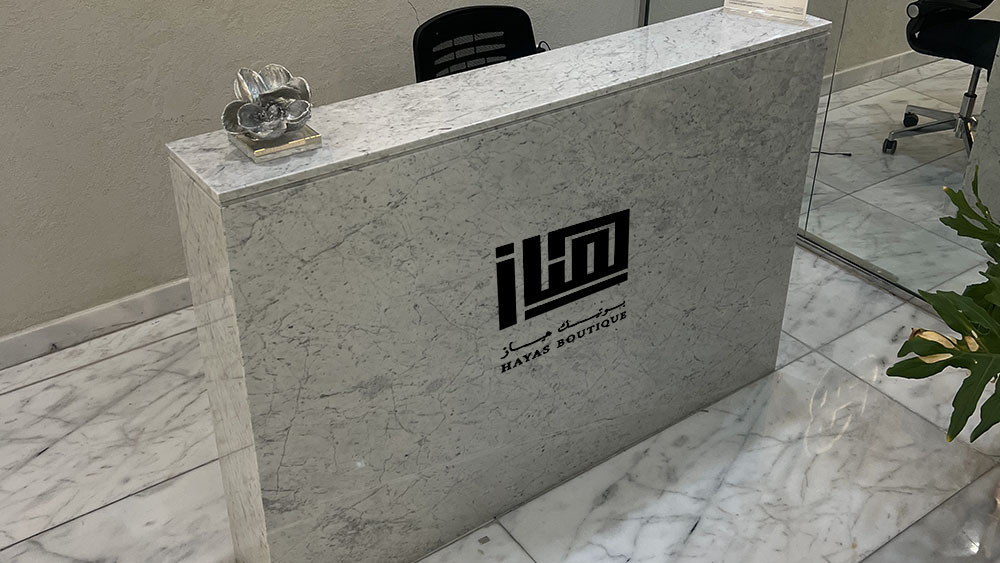
Cut direction and the position of joints influence whether markings seem to continue across adjoining pieces or create a deliberate contrast. A counter with a front, sides and top needs those views considered together; flooring and cladding also need an arrangement that makes sense across the wider surface.
Explore individual stones in the materials library for their character and selection guidance. For the commission, identify the appearance you want to carry across the finished work rather than expecting every piece to repeat a photograph.
Cutting, carving and shaped detail
Waterjet cutting produces profiles through stone slabs, including curved or fluid outlines. Three-dimensional machining and carving develop volume, recesses and changes in depth within solid stone. A flowing outline and a sculpted form therefore involve different decisions: define both the shape seen from above and the depth or contour needed through the piece.
For a patterned or branded feature, the size of the motif, its depth and the space around it affect how clearly it reads. For shaped furniture, transitions between faces and the placement of openings matter from the side as well as from the front. Hand-carved and hand-finished detail can form part of the work where the design calls for it.
Edges, surface finish and visible junctions
An edge profile changes the outline of a top or counter, while its relationship to the adjoining face changes how substantial the piece appears. Show which edges will remain exposed and which will meet cabinetry, another stone component or a surrounding finish.
Polished stone gives a more reflective surface; honing produces a lower sheen. A textured face creates a different effect again. The finish must be considered for the selected stone and use: the same appearance is not automatically available or appropriate across every stone and application.
Where several faces meet, the brief needs to address both the finish on each face and the transition between them. A strong contrast may be intentional, while a quieter composition depends on how closely the surfaces relate.
Counters, cladding and flooring in their setting
Fitted stonework needs to meet the actual surrounding construction. A counter relates to the cabinetry beneath it and any openings within the surface. Cladding follows wall dimensions, corners and adjacent finishes; flooring introduces layout decisions at room boundaries and transitions to other surfaces.
Identify what remains in place, where joints can occur and how the pieces will reach their installation position. The support and receiving surfaces need to be resolved with the dimensions and extent of installation for that commission.
If the brief is for the whole cabinetry arrangement rather than the stone counter alone, use Kitchens & Cabinetry. A wider room commission belongs under Interior Design & Turnkey Fit-Out.
Explore delivered stonework projects
Explore the project records for the stone pieces and fitted surfaces commissioned, their setting and the work delivered.


Discuss your stonework commission
Share the piece or surface you need, its location and intended use, with available dimensions, drawings or photographs. Include your preferred stone appearance, shape and finish, plus any existing elements it must meet. Indicate the fabrication and installation work you need so the enquiry starts with a clear scope.